How to Optimize Your Website for Google AI Overviews in 2026
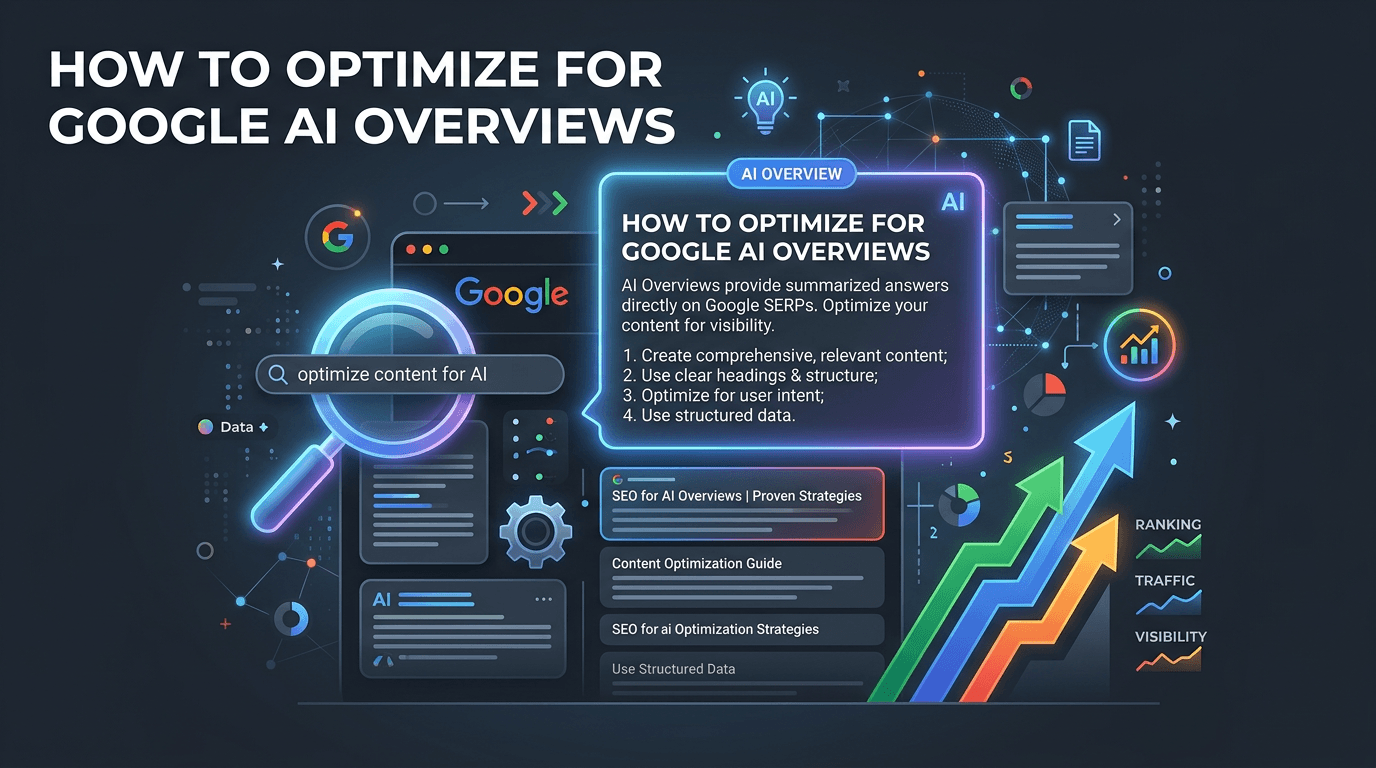
Google AI Overviews — the AI-generated summaries that appear at the top of search results — have fundamentally changed how users interact with search. Instead of scrolling through ten blue links, many users read the AI-generated answer and leave without clicking anything. For website owners and developers, this is both a threat and an opportunity.
The threat is real: sites that previously ranked well are seeing organic click-through rates drop significantly on informational queries where AI Overviews now dominate. The opportunity is equally real: if Google pulls from your content to build its AI answer, your site gains authoritative visibility — and the users who do click are highly qualified.
This guide explains exactly how Google AI Overviews work, which sites get cited, and the concrete steps you can take to make your content one of the sources Google draws from.
What Are Google AI Overviews?
Google AI Overviews (previously called Search Generative Experience or SGE during testing) are AI-generated summaries displayed at the very top of search results for many queries. They synthesise answers from multiple web sources and typically include citations — small source cards linking back to the pages Google drew from.
They appear most commonly for:
How-to questions ("how to install SSL on Ubuntu")
Explanatory queries ("what is a CDN")
Comparison queries ("Wordfence vs Sucuri")
Multi-step process questions ("how to submit a sitemap to Google")
They appear less commonly for transactional queries (buying intent), very recent news, or highly localised searches — though this continues to expand.
How AI Overviews Affect Organic Traffic
The impact varies heavily by query type. Studies tracking click-through rates since AI Overviews rolled out broadly show:
Informational queries: CTR drops of 20–60% on queries where AI Overviews appear, because users get the answer without clicking.
Commercial and transactional queries: Minimal CTR impact. Users searching to buy or compare still click through to evaluate options.
Brand and navigational queries: No significant impact. Users searching for a specific site still go there.
For technical blogs like this one — covering WordPress, Cloudflare, server setup, and SEO — the majority of content is informational. That means AI Overviews are directly relevant to traffic performance.
The counter-intuitive finding, though, is that being cited in an AI Overview can increase brand impressions significantly even when raw clicks drop. Users see your domain name as a trusted source next to the AI answer. Over time, this builds familiarity that converts on future queries.
What Content Gets Featured in AI Overviews
Google has not published a technical specification for what qualifies a page to be cited in an AI Overview, but analysis of thousands of citations reveals consistent patterns:
Pages that already rank on page one. AI Overviews overwhelmingly cite pages in the top 10 organic results for the same query. Ranking well remains a prerequisite — AI Overviews do not pull from obscure pages that are not already trusted by Google's ranking systems.
Content that directly answers the query in the first few paragraphs. Google's AI system looks for clear, concise answers near the top of the page. Burying the answer deep in a long article reduces the chance of being cited.
Structured content with headers, lists, and steps. Content broken into logical sections with descriptive H2 and H3 headings, numbered steps, and bullet lists is far more frequently cited than dense paragraphs of prose.
Pages with strong E-E-A-T signals. Experience, Expertise, Authoritativeness, and Trustworthiness — Google's quality framework — heavily influences AI Overview source selection. Pages with author bios, cited sources, original data, and demonstrable expertise are preferred.
Fast, mobile-friendly pages. Core Web Vitals and page experience signals correlate with AI Overview citations. A slow page or one that fails mobile usability checks is at a disadvantage.
How to Structure Your Content for AI Overviews
The most actionable changes you can make are structural. AI systems parse content the same way a well-organised reader would — they look for clear signals about what a section is about and what question it answers.
Use a Direct Answer at the Top
For any query your article targets, include a clear, 2–3 sentence answer in the opening section — before the background context or history. This is sometimes called a "TL;DR" or "quick answer" block. Think of it like an inverted pyramid: most important information first.
Example: If your article is titled "What is a CDN?", the very first paragraph should define what a CDN is in plain language. The deeper explanation follows after.
Use Descriptive H2 and H3 Headings
Each section heading should be a complete, descriptive phrase — not a clever or vague label. Compare:
Vague: "The Setup Process"
Descriptive: "How to Set Up a Cloudflare Firewall Rule to Block Countries"
Descriptive headings help Google understand what each section answers. AI systems use headings as anchors to extract relevant passages.
Use Numbered Lists for Processes
Step-by-step processes should always be numbered lists, not paragraphs. AI Overviews frequently reproduce numbered steps verbatim from source pages. A process buried in prose is almost never cited; the same process as a clean numbered list regularly is.
Add a FAQ Section
A Frequently Asked Questions section at the bottom of your article — with each question as a heading and a concise 2–4 sentence answer — is one of the highest-yield additions you can make. AI Overviews frequently pull from FAQ sections because they are already structured as question-answer pairs, which is exactly what an AI Overview is trying to produce.
Implement Schema Markup
Schema markup is structured data you add to your HTML that explicitly tells Google what type of content is on the page and how to interpret it. While Google has not confirmed that schema markup directly determines AI Overview inclusion, pages with proper schema are disproportionately represented in citations — likely because schema correlates with well-organised, authoritative content.
The most relevant schema types for a technical blog:
Article Schema
Use Article or TechArticle schema on every blog post. Include the author name, publication date, and modified date. Google uses these signals when evaluating freshness and authorship.
{
  "@context": "https://schema.org",
  "@type": "TechArticle",
  "headline": "How to Optimize Your Website for Google AI Overviews",
  "author": {
    "@type": "Person",
    "name": "Aniket Bhawkar",
    "url": "https://www.aniketbhawkar.com/about"
  },
  "datePublished": "2026-05-21",
  "dateModified": "2026-05-21",
  "publisher": {
    "@type": "Person",
    "name": "Aniket Bhawkar"
  }
}
FAQPage Schema
If your article includes a FAQ section, wrap it in FAQPage schema. This makes each question and answer machine-readable and significantly increases the likelihood Google pulls from your FAQ in an AI Overview.
{
  "@context": "https://schema.org",
  "@type": "FAQPage",
  "mainEntity": [
    {
      "@type": "Question",
      "name": "Do Google AI Overviews hurt organic traffic?",
      "acceptedAnswer": {
        "@type": "Answer",
        "text": "Yes, for informational queries, AI Overviews reduce click-through rates because users can read the answer without visiting a website. However, being cited as a source increases brand visibility."
      }
    }
  ]
}
HowTo Schema
For tutorial-style content with numbered steps, HowTo schema is highly effective. It marks up each step individually, making your process content directly machine-readable for AI systems.
Build E-E-A-T Signals
Experience, Expertise, Authoritativeness, and Trustworthiness (E-E-A-T) is not a direct ranking factor but a framework Google's quality raters use to evaluate pages — and it strongly influences which content is trusted enough to appear in AI Overviews.
Add an Author Bio
Every article should have a visible author byline linking to an author profile page. The author profile should list credentials, experience, and links to social profiles (LinkedIn in particular). Google cross-references author identity across the web — a consistent online presence strengthens authoritativeness signals.
Cite Your Sources
When you make factual claims — statistics, security advisories, version numbers — link to the original source. Citing authoritative external sources (official documentation, research papers, established publications) is a strong trust signal. It shows Google your content is grounded in verifiable information rather than speculation.
Keep Content Up to Date
Outdated content is actively penalised in AI Overview selection. Google strongly prefers fresh sources, particularly for technical topics where advice changes frequently (WordPress security, Cloudflare features, security vulnerabilities). Update your publication date and revise the content whenever the underlying information changes — not just cosmetic edits.
Earn Backlinks from Authoritative Sources
Domain authority still matters. Pages on sites with strong backlink profiles from trusted domains are more likely to be cited. For a technical blog, this means pursuing links from WordPress.org, developer forums, GitHub discussions, and industry publications rather than generic link directories.
Adapting Your Strategy for Zero-Click Searches
AI Overviews accelerate a trend that has been growing for years: zero-click searches, where the user gets what they need from the search results page without ever visiting a website. This requires a strategic shift in how you think about content goals.
Prioritise bottom-of-funnel content. Tutorials, comparisons, and buying guides that lead toward a decision or action still drive clicks. Pure informational content ("what is X") is increasingly zero-click territory. Shift content investment toward content that serves users who are ready to act.
Build your email list and direct audience. Users who subscribe to your newsletter or follow you on social are not dependent on Google's algorithm. AI Overviews do not affect direct traffic. Growing a direct audience insulates you from algorithmic shifts.
Use AI Overviews as brand exposure, not just traffic. Track impressions, not just clicks. If your domain appears in AI Overview citations for high-volume queries, that is genuine brand building — even if the click count looks lower than before.
Target long-tail, specific queries. AI Overviews are less likely to appear for highly specific, niche queries. "How to block a specific IP range using Cloudflare WAF rules in a free plan" is less likely to trigger an AI Overview than "how to use Cloudflare." Niche specificity protects click-through rates.
Tools to Monitor AI Overview Appearances
Measuring how often your site appears in AI Overviews — and on which queries — is important for understanding your visibility and adjusting your content strategy.
Google Search Console: The Performance report now includes AI Overview impression data for sites where it is available. Filter by query to see which searches generate AI Overview appearances for your pages.
Manual search checks: Regularly search your target keywords in an incognito window and note whether an AI Overview appears and whether your site is cited. This does not scale but gives you qualitative insight quickly.
Third-party rank trackers: Tools like Semrush, Ahrefs, and Mangools have added AI Overview tracking to their SERP feature reports. They can show you which of your tracked keywords now have AI Overviews and whether you are appearing as a source.
Google Alerts: Set up alerts for your domain name. If other publications start citing your content as a source when discussing AI Overview rankings, that is a signal that your E-E-A-T is being recognised across the web.
Should You Try to Block AI Overviews?
Some site owners, frustrated by traffic losses, have explored blocking Google's AI from crawling their content. This is technically possible via the robots.txt directive:
User-agent: Google-Extended
Disallow: /
Google-Extended is the crawler Google uses for AI training and AI Overview source collection. Blocking it prevents your content from being used in AI Overviews.
However, this trade-off is rarely worth it. Blocking AI Overview collection does not restore your organic rankings — those are unaffected. What you lose is the brand exposure from citations. You still take the traffic hit (AI Overviews can appear using content from other sources on the same topic), but without the upside of your domain being named. For most sites, being cited in AI Overviews — even with lower direct click volume — is the better outcome.
The exception is sites monetising primarily through on-page ads, where every click counts and brand exposure has less measurable value. For those sites, blocking AI Overview collection may be a defensible choice.
Summary: What to Do Right Now
If you want to optimise your site for Google AI Overviews today, start with these high-impact actions:
Add a direct answer summary at the top of each article targeting informational queries.
Rewrite vague section headings to be fully descriptive question-answer phrases.
Convert prose-based processes to numbered step lists.
Add a FAQ section to your most-visited articles with schema markup.
Implement
TechArticleorArticleschema on every post with accurate author and date data.Update your oldest articles — refresh the date, revise outdated advice, and add any new information.
Check Google Search Console for AI Overview impressions and identify which pages are already appearing.
AI Overviews are not going away. Google's direction is clear, and the sites that adapt their content structure and authority signals now will be the ones cited consistently as AI-powered search continues to evolve.